
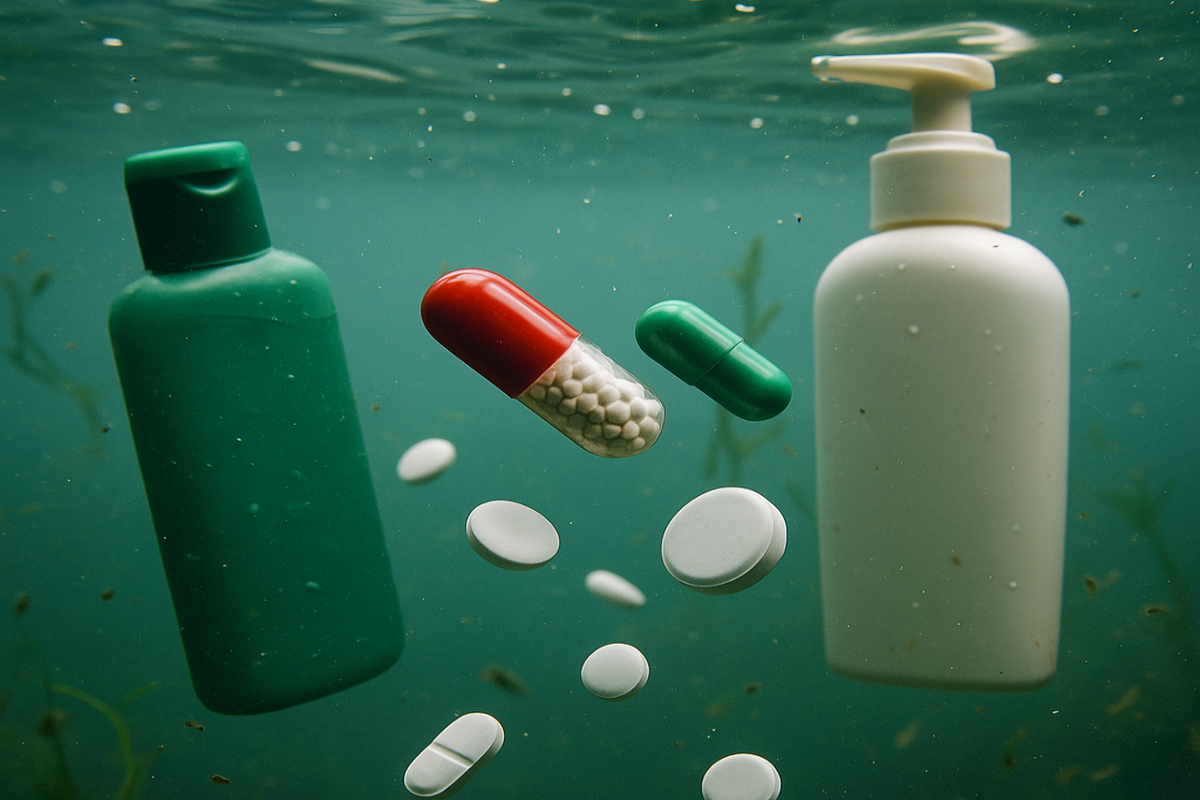
The new challenge: Drugs and cosmetics in water

Micropollutants are currently one of the most relevant topics in the field of wastewater treatment.
Pharmaceuticals and cosmetic products that reach watercourses disrupt the natural functioning of plant and animal life and are almost indestructible.

These substances belong to the group of micropollutants and enter water systems in several ways — through sewage networks via the human body, through improperly disposed of unused medicines, and through wastewater discharged from manufacturing facilities that produce such products.

As the market for pharmaceuticals and especially cosmetic products grows daily, so does the need for efficient methods of removing these pollutants from wastewater.
Current data show that a certain concentration of micropollutants has been found in almost all European rivers, and Serbia is no exception.

In the study Survey on the Micro-pollutants Presence in Surface Water System of Northern Serbia and Environmental and Health Risk Assessment (2018), conducted in Vojvodina across four rivers, one irrigation canal, and two lakes, 127 micropollutants were detected out of a total of 940 analyzed substances.

Once these substances reach rivers and lakes, they accumulate over time because they are chemically stable and difficult to degrade.
Hormonal drugs (such as contraceptives and estrogens) cause feminization in fish — males develop female characteristics, which threatens reproduction.
Antibiotics in water disturb the microbiological balance and kill beneficial bacteria, while analgesics (such as diclofenac) cause liver and kidney damage in fish and birds.
These substances alter the chemical composition of water and affect phytoplankton, algae, and insects, disrupting the entire food chain.

Cosmetic products such as shampoos, soaps, lotions, creams, and perfumes have a similar negative impact — they alter enzymatic activity and metabolism in aquatic organisms.

Wastewater treatment plants around the world struggle to eliminate micropollutants, as conventional systems are designed to remove organic matter, not complex chemical compounds.
The Netherlands has gone the furthest in this field, developing advanced technologies to eliminate such pollutants.
The process combines biological activated carbon filtration (BAC) and oxidative treatment using ozone or hybrid oxidants, achieving high efficiency in removing pharmaceuticals and cosmetic chemicals from water.

Addressing micropollutants has become a global priority, as they know no borders — they enter rivers, lakes, and groundwater, and ultimately the food chain.
The Dutch example shows that progress is possible through innovation, cooperation between science and government, and a long-term vision for environmental protection.
For Serbia, this means it is time to start considering the “fourth stage” of wastewater treatment already in the planning phase of new plants and sewage infrastructure — to protect future generations from the pollution we cannot see but which is already transforming our world.

photo: ilustration AI

Wastewater treatment is one of the priorities

Although there are activities and visible progress, it is necessary to engage even more in the implementation of the Action Plans of the Wastewater Management Strategy in Serbia, it is stated, among other things, in the report of the State Audit Institution (DRI) titled “Effectiveness of measures to protect water from pollution in order to improve water quality.”

According to the data of official statistics in 2021, only 28% of cities and municipalities had some kind of wastewater treatment provided before their discharge into rivers, while in 105 cities and municipalities, treatment of waste water discharged into public sewers was not provided. During the year 2022, 81.5% of the total wastewater discharged into public sewers was not subjected to purification treatment before being discharged back. Purification was provided for 18.5% of the total amount of wastewater discharged into public sewers, which is 3.2% more than in 2015.

In the mentioned report, it is further stated that based on the analysis of official statistical data on the change in the number of households connected to the sewage network in the period from 2016 to 2021, it was determined that the number of households connected to public sewage systems in 107 cities and municipalities increased in total for 112,971. According to official statistics, at the end of 2021, wastewater treatment with at least secondary treatment was provided in 36 cities and municipalities, of which five cities and municipalities did not have such treatment in 2015. The aforementioned changes also had an impact on the increase in the population’s connection to public sewage systems, where at least secondary wastewater treatment is provided.

In the period from 2016 to 2021, the number of households that have a connection to public sewerage with provided purification of municipal waste water with at least secondary treatment, in cities and municipalities where this treatment was provided even before 2016, increased by 26,353. In addition, in five cities and municipalities where at least secondary treatment of municipal wastewater was established in the same period, a total of 55,112 households were connected to the sewage network in 2021, which represents 68% of the total change in the number of households that have a connection to the public sewage system with at least secondary treatment of municipal waste water provided compared to 2015. In Water management strategies on the territory of the Republic of Serbia for the period from 2021 to 2023 it was planned to implement nine activities of construction, reconstruction or extension of wastewater treatment plants with expansion and reconstruction of the sewage network.

Progress in reducing discharged untreated wastewater in the Republic of Serbia is monitored through an indicator that shows the share of residents connected to urban wastewater treatment with at least secondary treatment. This indicator records constant growth, and in the period from 2016 to 2021 it increased by 3.85%. According to data published by the Statistical Unit of the United Nations, the share of household wastewater flows that are safely treated in the Republic of Serbia was 36.48% in 2022, which is 9.42% more than the published data for 2020. According to the data of the Environmental Protection Agency, the participation of water bodies that have good water quality in the environment (good ambient water quality) for the period from 2017 to 2019 is 69%, which is 1.6% more than for the period 2014-2016. years. Data on the share of water bodies with good water status on the United Nations Statistical Unit portal are available only for the year 2020. Between the values of this indicator for the year 2020 on the portal of the United Nations Statistical Unit and the Republic Institute of Statistics, there are differences, which are most pronounced when it comes to the participation of river water bodies with good water status, according to the report.

The implementation of the “Clean Serbia” Project is Serbia’s realistic answer and a sustainable solution for wastewater treatment, because the implementation of this project has two main programs: the construction of a sewage network and facilities for the treatment of wastewater and repair, reconstruction, recultivation and the construction of regional centers for solid municipal waste management. The project plans for the construction of 165 wastewater treatment plants. .

At the ecology fair and about wastewater treatment

The 18th International Energy Fair and the 19th International Fair of Environmental Protection and Natural Resources – EcoFair were opened in Belgrade. self-governments, utility companies, waste generators, professional public. The aim of Ecofair is to raise awareness of the importance of environmental protection, promote sustainability and provide a platform for the exchange of ideas, information and innovation related to environmental issues.

Ecofair also proved to be an excellent platform for connecting various actors in the field of environmental protection, such as non-governmental organizations, institutions, companies, activists and experts. This is an opportunity for the public to become familiar with the work and initiatives of organizations dealing with ecology and to encourage the engagement of citizens in environmental protection.

Finally, the emphasis of this manifestation is on the financing and management of projects in the sector of environmental protection, investment projects and waste management, purification and management of waste water, industrial safety and domestic legislation related to this issue. The essence of the complete agenda of this fair event is the ultimate demand and promotion of environmentally friendly behavior as a way of life.

The fair lasts until November 30, and an important place is the aspect of wastewater treatment throughout Serbia, which is one of the tasks of the “Clean Serbia” project, the implementation of which foresees the construction of 165 treatment plants.