
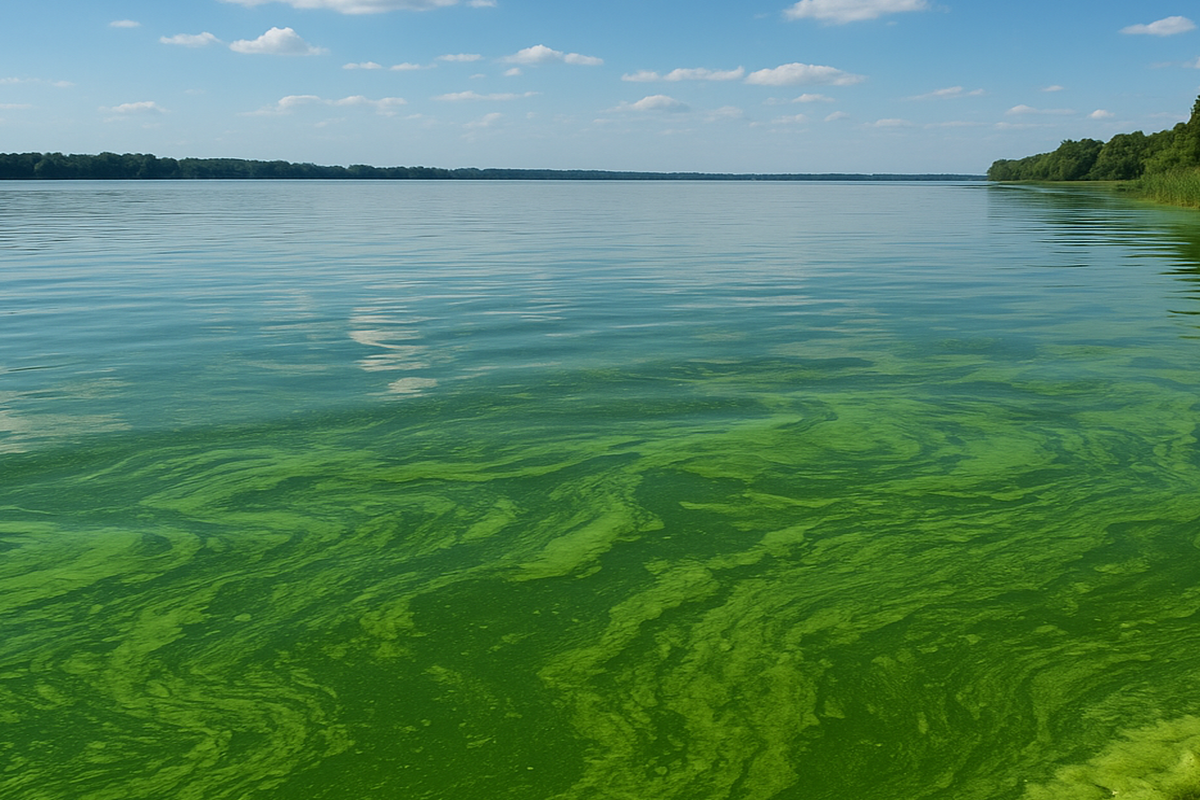
Eutrophication is becoming a threat to ecosystems

In some lakes and rivers in Serbia, the process of eutrophication is evident. This process occurs most often due to the absence of sewage systems and wastewater treatment processes.

Eutrophication occurs when water becomes overly enriched with nutrients, primarily nitrogen and phosphorus. These nutrients come from:
• Wastewater (domestic and industrial)
• Agricultural fertilizers (runoff from fields)
• Detergents and other chemicals

This process manifests as excessive growth of algae and aquatic plants (so-called “algal blooms”), a decrease in oxygen levels in the water when algae die and begin to decompose, the appearance of unpleasant odors, and turbid water.

The consequences of eutrophication are: the death of fish and other aquatic organisms due to lack of oxygen, reduction of biodiversity (variety of species), changes in the chemical composition of water, which makes its use for drinking, recreation, or irrigation more difficult.

According to available information, lakes with evident eutrophication in Serbia include Palić and Ludaš, Međuvršje, the Zobnatica reservoir, and some others.

The United Nations Environment Programme (UNEP), which studies challenges related to phosphorus pollution and its impacts on biodiversity and ecosystems, particularly highlights eutrophication of aquatic systems as a growing problem. “Globally, phosphorus losses from land to freshwater have doubled in the last century and continue to rise. Despite significant efforts to reduce nutrient pollution,” the program states.

Phosphorus was discovered more than 350 years ago and is an essential nutrient that helps plants grow. Its primary use is in the production of synthetic fertilizers to increase crop yields, making it crucial for food security. Phosphorus is also a key component of animal feed and is used in steel production, food additives, batteries for electric vehicles, certain pesticides, and household cleaning products.

The UN does not rule out the continued use of phosphorus but emphasizes that the key is to use it more sustainably and prevent excessive amounts from entering the environment.

“Wastewater releases about 3 million tons of phosphorus into the environment worldwide each year. Proper treatment could reduce phosphorus and nitrogen concentrations in wastewater by at least 80%. Solutions will require innovations—not only in technology but also in operational methods and cooperation between sectors that have traditionally not collaborated,” states the UNEP website.

Sombor: Preparation of environmental impact study

The City of Sombor has submitted a request for an environmental impact assessment for the construction of a sewage network and a wastewater treatment plant in Stanišić, as part of the “Clean Serbia” project, Dnevnik reports.

“Considering that the planned works include the reconstruction of streets, in the area of Cara Lazara Street, with a length of 1,700 meters, the construction of a new sewage network with about 420 household connections, as well as 9 kilometers of accompanying sewage network and one pumping station, is planned. The construction will be carried out in phases. The first phase covers Cara Lazara Street with a length of 1,700 meters and the construction of a pumping station. The second phase, which refers to the continuation of the network construction, includes about 420 household connections,” the documentation states.

According to the report, the environment will not be endangered, as wastewater will be directed to treatment facilities, eliminating the possibility of deterioration of recognizable environmental elements.

“Since in part of Cara Lazara Street, from house number 212, it was not possible to connect those parts of the settlement to the vacuum sewage system, a classic gravitational drainage system with one pumping station is planned for this area. The shaft-type pumping station, located at the end of Cara Lazara Street, will transfer the water to a shaft in Oslobođenja Street, at house number 196, where the wastewater will be introduced into the vacuum sewage system,” the submitted request states.

The public and interested organizations may submit their opinions and suggestions within the prescribed procedure, Dnevnik reports.

UN SDG – Progress in the treatment of domestic wastewater

According to the latest data from the United Nations Sustainable Development Goals (UN SDG), approximately 56% of domestic wastewater worldwide was safely treated in 2024, meaning it underwent at least secondary treatment in accordance with national or local standards. This data covers about 92% of the global domestic wastewater flow and includes more than 140 countries and territories.

In 2022, it was recorded that out of a total of 268 billion cubic meters of generated domestic wastewater, around 155 billion cubic meters were safely treated before being discharged into the environment. However, a significant portion, about 44%, still did not undergo adequate treatment, posing a serious challenge for water quality preservation and environmental protection.

These data highlight the importance of further investment and accelerated efforts in building and modernizing wastewater collection and treatment systems, especially in countries with underdeveloped infrastructure. Projects such as “Clean Serbia” contribute to this global goal by modernizing local utility networks and raising environmental protection standards.

Further progress in wastewater treatment is crucial to achieving UN SDG Target 6.3, which aims by 2030 to significantly reduce pollution, eliminate the discharge of untreated wastewater, and increase recycling and safe reuse of water globally.

Clean Serbia – Works progressing in Kučevo

Extensive works are underway in the municipality of Kučevo as part of the “Clean Serbia” project. In the town itself, construction of the main collector, as well as the water supply and sewerage network in the lower part of the settlement, is nearing completion, which will significantly improve municipal infrastructure and the quality of life for residents. Once these works are finished, road infrastructure will be renovated, followed by the reconstruction of five streets.

Works are also being carried out in other settlements within the municipality, ensuring balanced development and better connectivity between local communities. The “Clean Serbia” project has long-term importance for Kučevo, as it not only modernizes utility networks but also contributes to environmental protection, which is particularly important for rural areas that have seen an increasing number of families returning in recent years.