Operational meeting in Vranje for better implementation of the project

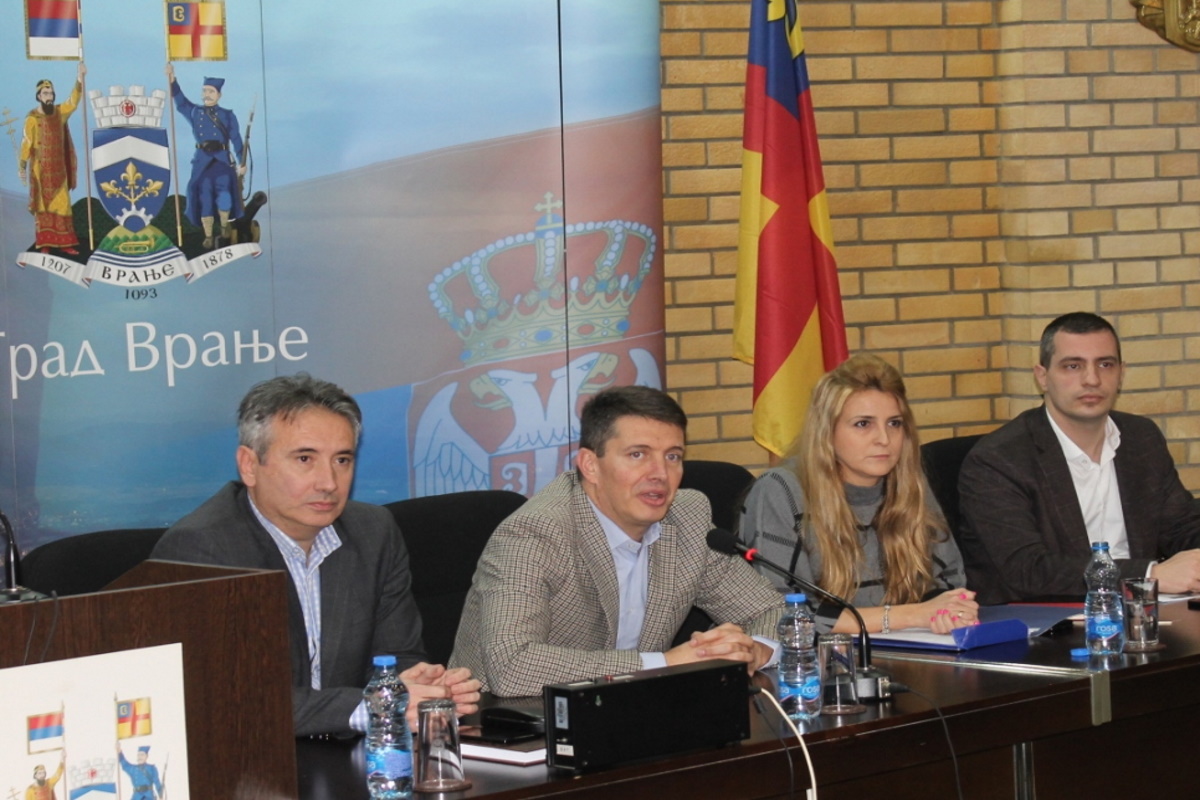
Representatives of the city of Vranje, the Ministry of Construction, Transport and Infrastructure and companies involved in the implementation of the “Clean Serbia” project held an operational meeting where the implementation of the project was analyzed.

The Mayor of Vranje, Slobodan Milenkovic, pointed out that the meeting is an opportunity to see what has been done so far, but also to see what is needed in order to continue the implementation of the project. The “Clean Serbia” project envisages the construction of 141 kilometers of sewage network worth 70 million euros in Vranje, as well as 33 kilometers in Vranjska Banja.

The meeting was also attended by the state secretary in the relevant ministry, Isidora Burić, as well as acting Assistant Minister Dušan Radonjić, who are in charge of monitoring the implementation of the “Clean Serbia” project throughout the country, and State Secretary Dragan Stevanović.

“The idea is to give importance to the south of Serbia. A lot of things have been done in Vranje in the past years in this area, because it is very important for us that the south of Serbia is in some way the focus, that’s why the “Clean Serbia” project was started from here. A serious and significant project for Vranje. There were problems during the implementation of the project, but that’s why we’re all here together, to react on time and solve them on the fly,” said Stevanović.

Vlasotince for the construction of the Wastewater Treatment Plant

At the session of the Assembly of the Municipality of Vlasotince, the proposed decision was voted on development of the Detailed Regulation Plan for the construction of the Central Wastewater Treatment Plant in Stajkovac, which will be built within of the “Clean Serbia” project.

Deputy President of Valsotinca Municipality Vladimir Kocić at the meeting reminded the assembly that planning documents are a prerequisite for the construction of the plant.

“You know that all major villages, the reconstruction of the city’s sewage system and the construction of a new plant are at stake. The location that was chosen was not chosen by chance. It is owned by the Republic of Serbia, it has enough square footage, the position is the best possible, so that all the villages could be connected to the sewage system. Expert services and commissions made a proposal. So it is the PDR for the plant, from the construction of a new transformer station and a connector from the old to the new plant in Stajkovac – said Kocic.

The implementation of the “Clean Serbia” project in the Municipality of Vlasotince, in addition to the aforementioned plant, also foresees the construction of a 76.4 km long sewage network that protects the South Morava River.

Through analysis and quality education to new professionals

The „Clean Serbia“ Project, which has a goal of preserving the environment and raising the living standard of residents through the construction of sewage network, wasteswater treatment plants i landfills more often than not runs into the problem of lack of professionals during the process of implementation.  Professor Dr. Dragan Povrenović, from the Department of Environmental Protection Engineering, who deals with the water and wastewater technologies, as well as with the biprocess engineering at the Faculty of Technological Metallurgy, says that, at the very beginning, we require an analysis of our own resources, a studious approach to various factors and more information for young people so that they may become successful and recognized in this field.

Back in 2017, certain Ministries of the Republic of Serbia indicated the problem of lack of professionals in the environmental field, which is necessary when one looks at the challenges of standard conformation and application in that field in the process of European integration. Not much has changed from then until now.

Above all, we are in a problem because we did not think ahead of time, who in Serbia should address those problems, in what way and in cooperation with which professionals or what do we already have available in Serbia? We often resort to having someone from the outside tell us that we have a problem and then we confirm it and see what can be done in a rush instead of having a domestic, studious approach that should also use other people’s experience, but primarily rely on local knowledge, local wisdom and experience and then we look at what the problem is, how big it is and how we can address it? This does not only apply to wastewater treatment and environmental protection, but also to a broader approach that has unfortunately been lost on us many times so far. At the beginning of everything, when it comes to solving any problem, we have to look at the capacities that we already have,”  Povrenović had to say.

Povrenović explains that assistance outside the country in addressing the problem can only be requested after we practically know what we are dealing with and after we have created a program on how to address the problem. If assistance is requested immediately, it does not necessarily have to be implemented in our country, because we may have a different structure of the problem, which leads to even more confusion, not a solution. “I don’t believe that when there is a problem in the house, we call a neighbor to solve the problem, but in accordance with our own capacities and resources, we solve our own problem.” We don’t have records of what we have and in which fields,” the professor explains.

Real practice indicates that if the Ministries have programs that they wish to implement, the Ministry of Education must be the one that will follow the requirements and development directions of those programs. Is the solution to finally gather both of them at a single place so that the work is synchronized?

We must understand that in the last twenty or more years, the staff in the Ministry of Education has been changing at such a pace that it is impossible to respond adequately from that position. Practically speaking, just before one receives certain information and starts working, there is a change in staff, so the new ones need time to be informed again and so on in a vicious circle. And this is not the case only with that ministry. Just take a look at how many people we have had in all ministries from 2000 up until now. Engaged among other things in innovation activities and the competition for the best technological innovations in Serbia, my colleague Ivana Begović is our ninth minister since 2005, with whom we are talking about this topic. This has a negative consequence, because really from personal experience, first being in the position of Deputy Minister, and then State Secretary in the Ministry of Science and Environment from 2004-2007, I personally know that it takes time to study something and see the problems, and only then can one, as the people would say, “take matters into your own hands” and start implementing and adopting the program. First of all, knowledge and a clear vision of what one wants to do during one’s mandate is necessary. Consistency is what is required,”  Professor Povrenović emphasized.

According to him, for 50 years, the Faculty of Technological Metallurgy has been dealing with environmental protection, teaching and research, so that any composition of the ministry did not determine what would be taught, but it was a need that was redefined, the teaching programs were renamed and the ministry itself does not have a major impact on the mentioned programs. “Many programs were verified in Serbia, without actually deserving to be verified. We in Serbia have, in certain university centers, places where certain issues are studied, somewhere more, somewhere less successfully, somewhere better, somewhere a bit worse, but we have a basic problem that in certain branches we do not gather to talk about what the basic problem is”, claims Professor Dr. Dragan Povrenović.

As someone who deals with wastewater treatment and technologies, but also with improving innovative activities and spreading awareness of the need to create innovations in all areas, especially in the environmental domain, Povrenović says that we seem to lack the calculation.

This is the most classic calculation, which is to take a pencil, write down the items, draw a line and then see what the result is. That is what we are fundamentally lacking, and above all, all eyes are turned abroad, where someone is waving at us some money which usually turns out to be much more expensive than we had previously imagined. The favorite discipline of decision makers when it comes to wastewater treatment is to go somewhere to see wastewater treatment because it seems they did not learn about it before, and what they immediately do is look at the surface of the water, and the water purification treatment is not done on the surface of the water but in its depth, and what lies in the depths, how it all works, can only be known by those who have dealt with problem solving. More than once have I encountered situations that range from funny to somewhat sad, where they turn to me and say, professor, we bought such and such a system, would you please explain to us what we bought? Now all those who read what I said should ask themselves, would they ever give their personal money for something they don’t know what it is?

Professor Dr. Dragan Povrenović points out that first of all we need to know what personnel we already have for certain problems in Serbia, primarily in the field of wastewater treatment, and only then make a decision about which and what quality personnel we should train. Only then, as Povrenović explains, should the public be informed about the staff we are talking about. “We have to talk about it in public so that young people understand that they really can build a career in certain branches.” I often have the opportunity to recommend a good student to a company, and many companies are looking for them, they are paid very well for our standards, but now young people think that only in the IT sector can something be achieved because such an environment has been created. That environment dictates that the IT sector will bring food and drink and water and everything else, and at the same time we have escaped from one basic condition for sustaining life, which is creation in all areas, not just one that is being promoted, which I’m afraid with one click can be moved to another meridian. It is up to us that those who make decisions gather quality people from this field or perhaps some other fields, but above all, the one who gathers must know who these quality people are and know the topic, and not for someone else to tell them or suggest it. That’s why we have to analyze not only who is where, but also who makes the decisions. It’s like that for every area of life”

Works in Novi Sad are progressiong at full speed

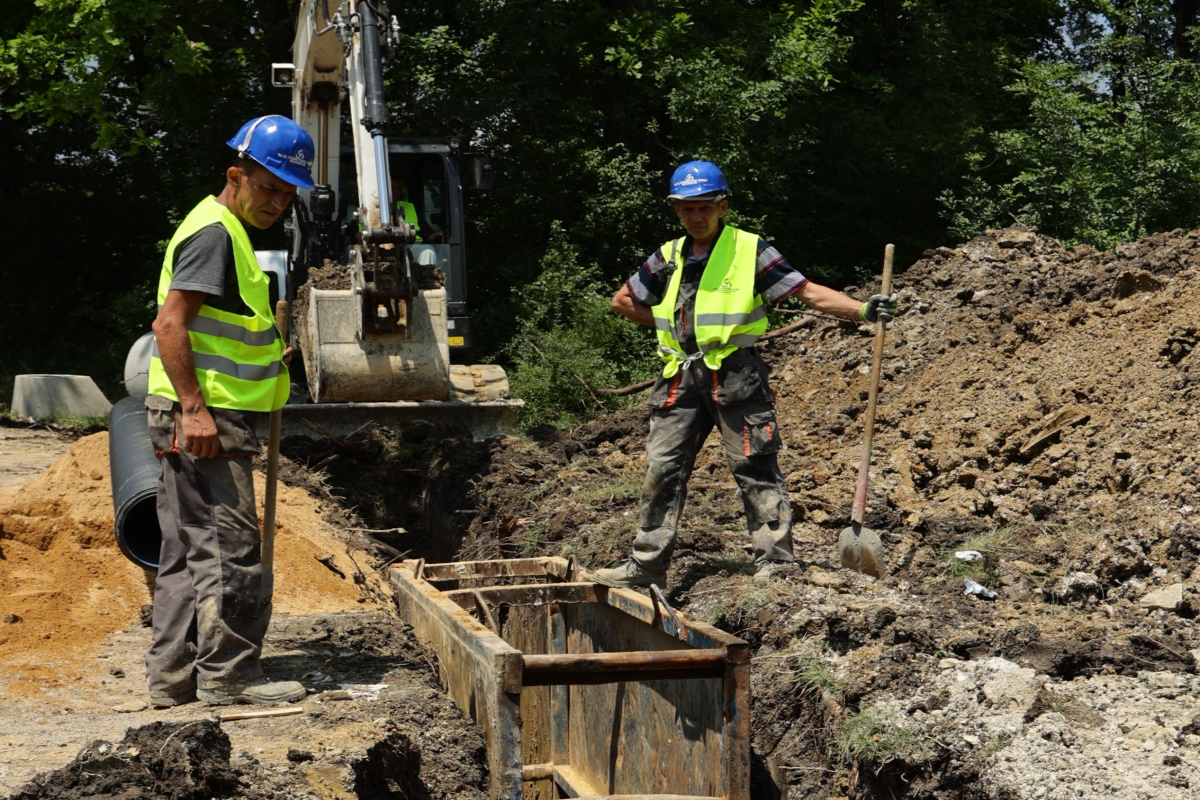
State Secretary in the Ministry of Construction, Transport and Infrastructure Isidora Burić and Assistant Minister Dušan Radonjić toured the works on the reconstruction of the sewage network in the Liman 2 settlement, which are being carried out as part of the “Clean Serbia” project.

The reconstruction of the sewage network at Liman 1 and 2 is important for Novi Sad, because the dilapidated sewage network was the cause of fecal pollution of the Štrand drinking water source, which has therefore been out of service since 2008. At the moment, about 20 kilometers of sewage network up to 50 years old are being reconstructed at these two locations, after which the conditions will be met for the revitalization of the Strand source, which with its capacity can meet 35 percent of Novi Sad’s raw water needs.

In Novi Sad, works are being carried out on the construction and reconstruction of 66.8 kilometers of the sewage network, while in the next stages another 45 kilometers of the network and the central treatment plant for waste water in Petrovaradin will be built.

“Clean Serbia” for the protection of the Mali Pek river

As part of the “Clean Serbia” project, in addition to the sewage network, a wastewater treatment plant (WWTP) will be built in Kladovo. The implementation of this project will protect the river Mali Pek.

In the municipality of Kladovo, waste water is directly poured into the Mali Pek river, which damages the biodiversity of the area.

The “Clean Serbia” project envisages that waste water will be transported to a processing plant that will be built not far from the city, near the former Veliki Srebra, Zlatara Majdanpek plant. The value of these works is slightly less than nine million euros.

The construction of the sewage network will cover the following settlements, villages and parts of the Kladovo municipality: Velika Vrbica – 7,788.48 m, Rtkovo – 6,471.66 m, Korbovo 7,675.98 m, Rit – 2,984.00 m, Brza Palanka – 2,287.00 m and Podvrška – 13,393.15 m.

87 million euros for “Clean Serbia” in Novi Pazar

During the talks between the Novi Pazar delegation and the ministers Goran Vesić and Husein Vemić, the implementation of the “Clean Serbia” project was discussed in particular.

The municipality of Novi Pazar is expecting investments worth 540 million euros next year. Among the significant projects for this city, the “Clean Serbia” project was mentioned in particular, in the realization of which 87 million euros.

“It is a historical matter not only for Novi Pazar but also for many other municipalities of ours. The construction of a wastewater treatment plant will fully satisfy the needs of the residents of Novi Pazar. All waste water in Novi Pazar will be processed and returned to nature as clean, which is our obligation to nature”.

The implementation of the “Clean Serbia” project envisages the construction of 110 kilometers of sewage network, and the plan is also to build a waste water treatment plant, the equivalent of 160 thousand users.

The Government of Serbia is developing the city of Čačak

The Minister of Construction, Transport and Infrastructure Goran Vesić, attended the celebration of the Day of the City of Čačak, where he announced several important projects for that city, in addition to the completion of the section of the highway from Pakovraća to Požega, Minister Vesić also spoke about the dredging of Lake Medjuvršje, as well as numerous infrastructure projects.

Minister Vesić indicated that in the Ministry he leads, there is program for the integration development of the Ovčar-Kablar gorge, which will include the dredging of Lake Međuvršje, the glass lookout point on Kablar with a visitor center.

“It is important that people see how beautiful the Ovčarsko-Kablar gorge looks. We will build a rehabilitation center in Ovčar spa, as part of the hospital, and the first ecological catamaran, which will be in that gorge”, said Vesić.

He added that now sewerage is being built in Serbia for more than 3.5 billion euros, so more than 69 municipalities will get sewerage for the first time.

“We are doing things that Sbrija has not done for centuries. It is time for Serbia to catch up with developed countries and for our people to finally live in the country they deserve. This is what people recognize”, said Minister Vesić

The silting of Lake Međuvršje is planned as part of the “Clean Serbia” project, thanks to the Agreement on Economic Cooperation with Hungary.

“Clean Serbia” begins work on Liman 1 in Novi Sad

Today, in the Liman 1 neighborhood in Novi Sad, construction work will begin on the construction of a sewer network within the “Clean Serbia” project.

The works carried out as part of the “Clean Serbia” project relate to the reconstruction of the sewage network, and these works will cover the area bounded by the streets of Fruškogorska, Bulevar Car Lazar (from the corner with Fruškogorska Street to the Quay of the Raid Victims) and Sunčani Quay, and the dilapidated quay will be reconstructed. primary and secondary sewerage networks, as well as existing sewerage house connections, with a total length of 11.2 kilometers.

The works started today will last until the end of 2023, and the PUC “Water and Sewerage” in Novi Sad is included in the implementation of the works.

The financier of the “Clean Serbia” project is the Ministry of Construction, Transport and Infrastructure of the Republic of Serbia, which selected the contractor for the work in question as well as the selection of the Supervisory Authority over the execution of the work.

The contractor is “China Road and Bridge Corporation”, CRBC Serbia branch Belgrade, with its subcontractors, in accordance with the “Clean Serbia” Project. EPTISA Beograd supervises the execution of works on behalf of Investors and financiers.

Works in Novi Sad are planned in phases: Novi Sad 66.8 km network – Phase 1, 24.9 km network + 1 WWTP – Phases 2 and 3.

Momčilović: In one year, 13 km of network in Kragujevac

The deputy mayor of Kragujevac, Ivica Momčilović, confirmed for local television that 13 kilometers of sewage network were built in Kragujevac in the past year as part of the “Clean Serbia” project.

The implementation of the “Clean Serbia” project in Kragujevac began at the end of November last year, and according to Momčilović, the sewage network has already been built in the parts of Opornica, Maršić, Mali Pčelica, Dena brdo, Beloševac, Ilićevo, Veliko polje and Petrovac. Certain streets have already been restored to their original state, and works are currently being carried out in 8 locations in Kragujevac.

“Since the beginning of the implementation of the “Clean Serbia” project, more kilometers of fecal sewage network have been constructed than in the previous 10 years in the city of Kragujevac. The section of works is done every two weeks. As the works are in progress in five city municipalities on 8 construction sites, the real state of completed works is about 13,000 meters”, Deputy Mayor Ivica Momčilović told InfoKG.

Currently, works are being carried out in Brđanska Street in Beloševac, Kikindska Street in Petrovac, Adam Gvozdenović Street in Grošnica, Bogoljub Đorđević Street in Ilićevo and Milutin Milanković Street and Koruška Street in Mali Pčelice.

“Milivoja Bankovića Sićka street has been restored to its original state, preparatory works for restoring it to its original state and related to the testing of the dynamic module are being completed in the streets: Dragiša Mišovića, Mladen Milovanovića, Bogoljub Đorđevića, Vladimira Pejovića, Brđanska, Braća Petrovića i Koruška, Travnička and Mirjane Jakoviljević. It is expected that they will soon be returned to the condition before the works were carried out”, announced Momčilović.

According to him, the next phase of the “Clean Serbia” project will include the reconstruction of the fecal sewage network in the central city core and on the collector network.

“The subdivision and expropriation of plots for the future landfill at the Vitlište location is being completed,” said the deputy mayor.

As part of the “Clean Serbia” project, the landfill in Jovanovac will be moved to a new location – Vitlište, which is located on the border between Korman, Maršić and Gornji Komarice.

Momčilović also stated that the “Clean Serbia” project lasts about five years.

Vojvodić: The construction of 4 centers for waste management

Aleksandar Vojvodić, chief engineer of CRBC, stated that the plan is to build 4 centers for waste management in Serbia.

In the third panel at the regional expert meeting on energy and ecology “Look up” held on Kopaonik; Green construction as an integral part of a sustainable future; about the “Clean Serbia” project implemented by the Government of Serbia with the CRBC company the chief engineer of CBRC, Aleksandar Vojvodić, spoke.

“CRBC, as part of its project and the contract it signed with the Government of Serbia, plans to build 4 centers for solid waste management, one will be located in Pančevo, the other in Kraljevo. At those two landfills, waste is selected and prepared for further use. As regards the next two landfills are in Kragujevac and Niš, they are landfills with larger capacities, at the end of construction they will either be regional landfills, the construction of an incinerator is also planned,” Vojvodić said.

The effect, apart from the removal of waste and reduction of pollution, is in the construction of incinerators itself, because by burning that waste, electricity and thermal energy are obtained.

“It also makes it possible to reduce the cost of taking or capturing the state’s resources because it is possible to cover part of the energy needs from its own capacities”, Vojvodić explained.

The “Clean Serbia” project and the CRBC company are also engaged in the construction of communal infrastructure in order to protect the rivers and provide a better standard of living for the residents.

“The second part that the company deals with is related to sewerage and waste water processing. Waste must be made harmless and then the question is what to do with it. That sludge, as harmless as it is, softens over time and is absorbed into the soil and in some way becomes a pollutant. CBRC has 157 plants on the territory of Serbia, in 77 municipalities, and that project covers 40 percent of the territory and population”, Vojvodić said.